What Makes Medical Education at UManitoba Unique?
The educational experiences of learners at the Max Rady College of Medicine are shaped by several distinctive features of the curriculum and learning environment:
-
A person- and community-centred curriculum. Rather than being organized primarily around organ systems or medical specialties, the UGME curriculum is designed around the needs of patients, families, and communities, integrating biomedical, clinical, behavioural, and social sciences throughout the four-year program.
-
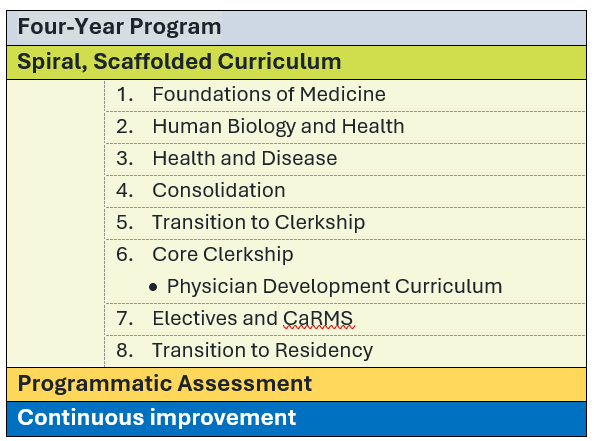
An integrated, spiral curriculum. Core concepts are introduced early and revisited throughout medical school with increasing complexity, allowing learners to deepen their understanding and apply previous learning in new clinical contexts.
-
Early and progressive clinical exposure. Students begin developing clinical skills, communication, and clinical reasoning early in the curriculum and build these competencies through increasingly authentic patient encounters before entering clerkship.
-
Distributed clinical education across Manitoba. Learners train in academic health sciences centres, community hospitals, ambulatory clinics, rural communities, northern Manitoba, and other distributed sites, providing exposure to a broad range of patients, practice settings, and healthcare systems.
-
A strong commitment to social accountability. The curriculum prepares physicians to meet the health needs of Manitoba's diverse populations, with particular attention to rural, remote, northern, and underserved communities.
-
Longitudinal Indigenous Health, Social Justice, and Anti-Racism education. Learners develop an understanding of Indigenous health, cultural safety, anti-racism, health equity, and the social determinants of health as themes integrated throughout the curriculum rather than isolated topics.
-
Clinical reasoning is intentionally taught. Throughout both classroom and clinical learning, students are expected not only to acquire knowledge but also to explain their reasoning, justify clinical decisions, and reflect on uncertainty and decision-making.
-
Feedback-rich learning. Learners are expected to actively seek feedback, reflect on their performance, and use coaching conversations to guide their ongoing development. Workplace-based assessment and narrative feedback are integral components of both undergraduate and postgraduate education.
-
Progressive responsibility. As learners demonstrate competence, they are entrusted with increasing responsibility for patient care while continuing to receive supervision appropriate to their stage of training. This principle continues seamlessly from clerkship into residency.
-
Residents as teachers. Residents are not only learners but also important teachers and supervisors of medical students. The PGME Core Curriculum includes formal teaching development to prepare residents for these educational roles
MRCoM's Undergraduate Program